
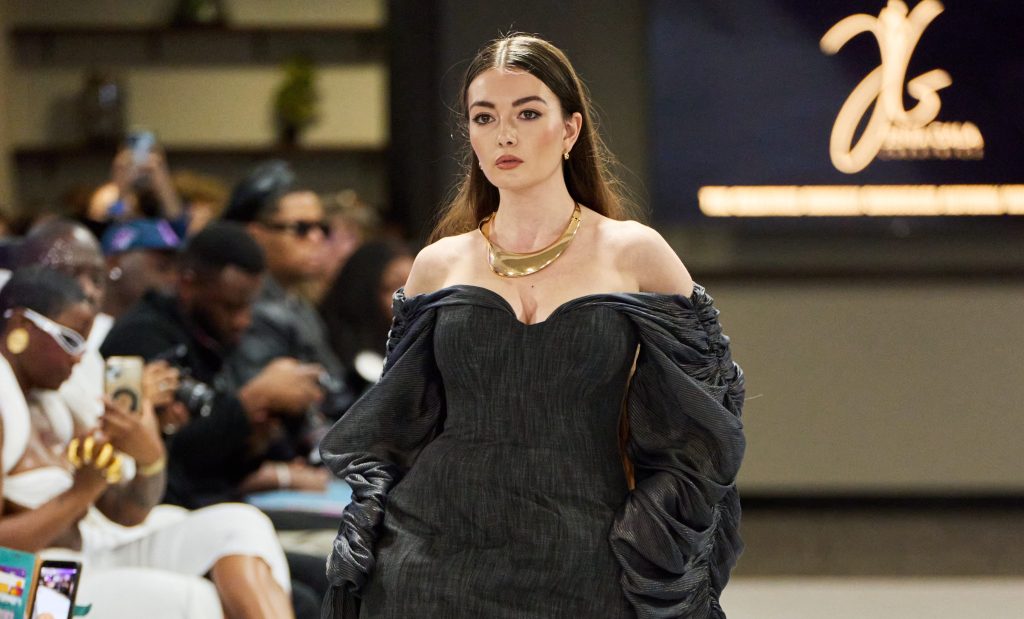
On September 19th, London Fashion Week welcomed the debut of Albanian designer Alisa Dudaj, whose latest collection, Silent Engravings, continued her exploration of heritage and contemporary refinement. Presented as her first London showing, the collection built on Dudaj’s reputation as a designer who merges artisanal craft with modern minimalism, while amplifying her voice within the global slow-fashion movement.
Inspired by her great-grandfather’s woodworking, Silent Engravings translated the artistry of carved forms into sculptural silhouettes and tactile finishes. Pieces featured intricate embroidery and textural layering that echoed the depth of engraved surfaces, yet were rendered in a palette and structure that felt pared-back and modern. The interplay of tradition and innovation—a hallmark of Dudaj’s practice—was evident throughout, honoring Albanian craftsmanship while reimagining it for an international audience.
A graduate of Parsons School of Design and a rising name since her 2022 Muza Competition win, Dudaj has steadily positioned herself at the intersection of cultural storytelling and contemporary design. Previous collections, such as Alpine Whispers at New York Fashion Week, highlighted her ability to translate folklore into modern forms. With Silent Engravings, she shifted her focus to materiality and structure, emphasizing clothing as both sculptural object and vessel of meaning.
The presentation underscored her commitment to slow fashion principles. Rather than fleeting trends, Dudaj’s work is anchored in longevity, cultural memory, and connection. Each piece asked the audience to consider clothing not as disposable product but as artifact—crafted with precision, carrying narrative, and designed to endure.
Behind the scenes with Alisadudaj
Q: For this season, what new inspirations shaped your silhouette or palette?
This season, I drew inspiration from the artistry of wood carvings. I’m fascinated by their intricate forms and the skill it takes to bring such shapes to life. Translating that sense of texture and craftsmanship into clothing allowed me to explore silhouettes that feel both sculptural and organic.
Q: How do you see Alisa Dudaj evolving its brand voice: more avant-garde, more wearable, more experimental—or a mix?
I see the brand moving toward something more wearable—without sacrificing craftsmanship or detail. Each piece will continue to require the same care and time to create, but the evolution lies in ease of wear and accessibility of the silhouettes. I want people to live in these clothes while still feeling that each one is special.
Q: Can you walk me through a piece from this collection that best represents your creative leap this season (design process, challenges, what makes it special)?
One standout piece is the carved wooden shoes, which are still in development. I was drawn to the idea of wearable wood carvings, but the biggest challenge has been comfort. While experimenting, I began exploring the possibility of adapting these designs through 3D printing. This approach could replicate the carved aesthetic in a more wearable and affordable way—bridging artisanal craft with future-facing technology.
Q: In terms of technique or fabrication, were there any discoveries or partnerships that shaped this collection?
Collaborating with an artist skilled in wood engraving opened an entirely new creative path for me. His mastery allowed me to envision textures and details I wouldn’t have been able to achieve alone. It’s an ongoing partnership that I believe will continue to inspire new directions in my work.
Q: What feedback from previous shows have you incorporated into your design or presentation here?
The most consistent feedback I’ve received was to consider wearability more closely. This season, I fully embraced that challenge—balancing artistry with function—and I feel I’ve found a harmony that allows the pieces to be lived in without losing their essence.
Q: With LFW being global in reach, how do you hope to translate your design values across different markets?
I want to bring a sense of identity back to clothing. To me, clothes are not just objects of consumption but vessels of story and meaning. In an era where fast fashion encourages disposability, I want my work to inspire people to value and connect with what they wear—wherever in the world they may be.
Q: What trends do you feel are misrepresented or overused at the moment—and how does your work aim to offer something different?
I believe every trend has its place, as long as it resonates with people. What I feel strongly about is not rejecting trends outright but rethinking consumption. The real issue is the waste generated by mindless, meaningless purchases. Through my work, I aim to create pieces that people invest in emotionally—garments that carry value, rather than being discarded at the end of a season.


 My Goddess Complex
Leave a comment