
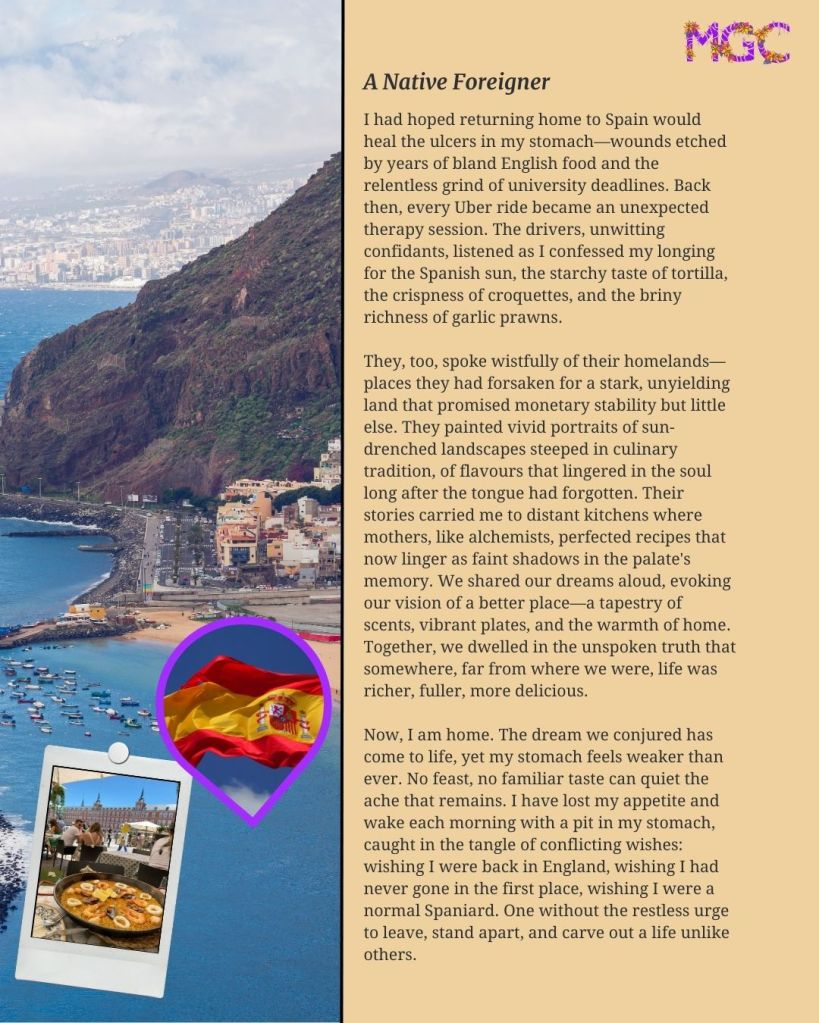
I had hoped returning home to Spain would heal the ulcers in my stomach—wounds etched by years of bland English food and the relentless grind of university deadlines. Back then, every Uber ride became an unexpected therapy session. The drivers, unwitting confidants, listened as I confessed my longing for the Spanish sun, the starchy taste of tortilla, the crispness of croquettes, and the briny richness of garlic prawns.
They, too, spoke wistfully of their homelands—places they had forsaken for a stark, unyielding land that promised monetary stability but little else. They painted vivid portraits of sun-drenched landscapes steeped in culinary tradition, of flavours that lingered in the soul long after the tongue had forgotten. Their stories carried me to distant kitchens where mothers, like alchemists, perfected recipes that now linger as faint shadows in the palate’s memory. We shared our dreams aloud, evoking our vision of a better place—a tapestry of scents, vibrant plates, and the warmth of home. Together, we dwelled in the unspoken truth that somewhere, far from where we were, life was richer, fuller, more delicious.
Now, I am home. The dream we conjured has come to life, yet my stomach feels weaker than ever. No feast, no familiar taste can quiet the ache that remains. I have lost my appetite and wake each morning with a pit in my stomach, caught in the tangle of conflicting wishes: wishing I were back in England, wishing I had never gone in the first place, wishing I were a normal Spaniard. One without the restless urge to leave, stand apart, and carve out a life unlike others.
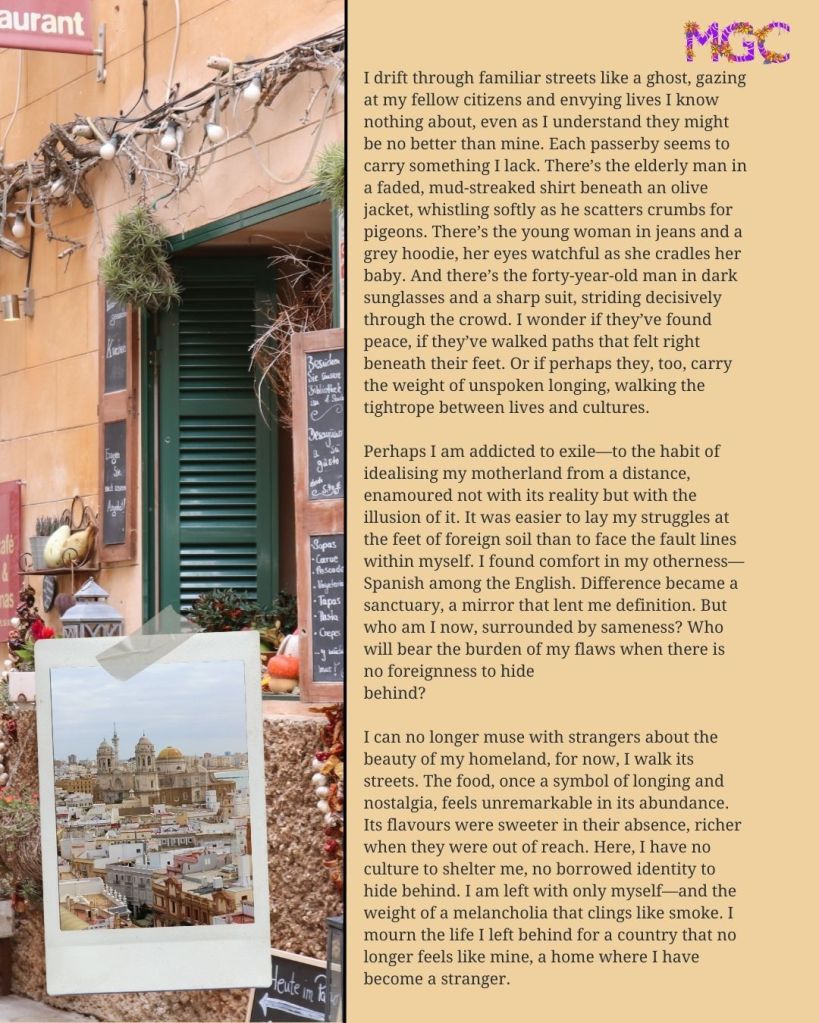
I drift through familiar streets like a ghost, gazing at my fellow citizens and envying lives I know nothing about, even as I understand they might be no better than mine. Each passerby seems to carry something I lack. There’s the elderly man in a faded, mud-streaked shirt beneath an olive jacket, whistling softly as he scatters crumbs for pigeons. There’s the young woman in jeans and a grey hoodie, her eyes watchful as she cradles her baby. And there’s the forty-year-old man in dark sunglasses and a sharp suit, striding decisively through the crowd. I wonder if they’ve found peace, if they’ve walked paths that felt right beneath their feet. Or if perhaps they, too, carry the weight of unspoken longing, walking the tightrope between lives and cultures.
Perhaps I am addicted to exile—to the habit of idealising my motherland from a distance, enamoured not with its reality but with the illusion of it. It was easier to lay my struggles at the feet of foreign soil than to face the fault lines within myself. I found comfort in my otherness—Spanish among the English. Difference became a sanctuary, a mirror that lent me definition. But who am I now, surrounded by sameness? Who will bear the burden of my flaws when there is no foreignness to hide behind?
I can no longer muse with strangers about the beauty of my homeland, for now, I walk its streets. The food, once a symbol of longing and nostalgia, feels unremarkable in its abundance. Its flavours were sweeter in their absence, richer when they were out of reach. Here, I have no culture to shelter me, no borrowed identity to hide behind. I am left with only myself—and the weight of a melancholia that clings like smoke. I mourn the life I left behind for a country that no longer feels like mine, a home where I have become a stranger.
- Blanca Lanzarot




 My Goddess Complex
Leave a comment